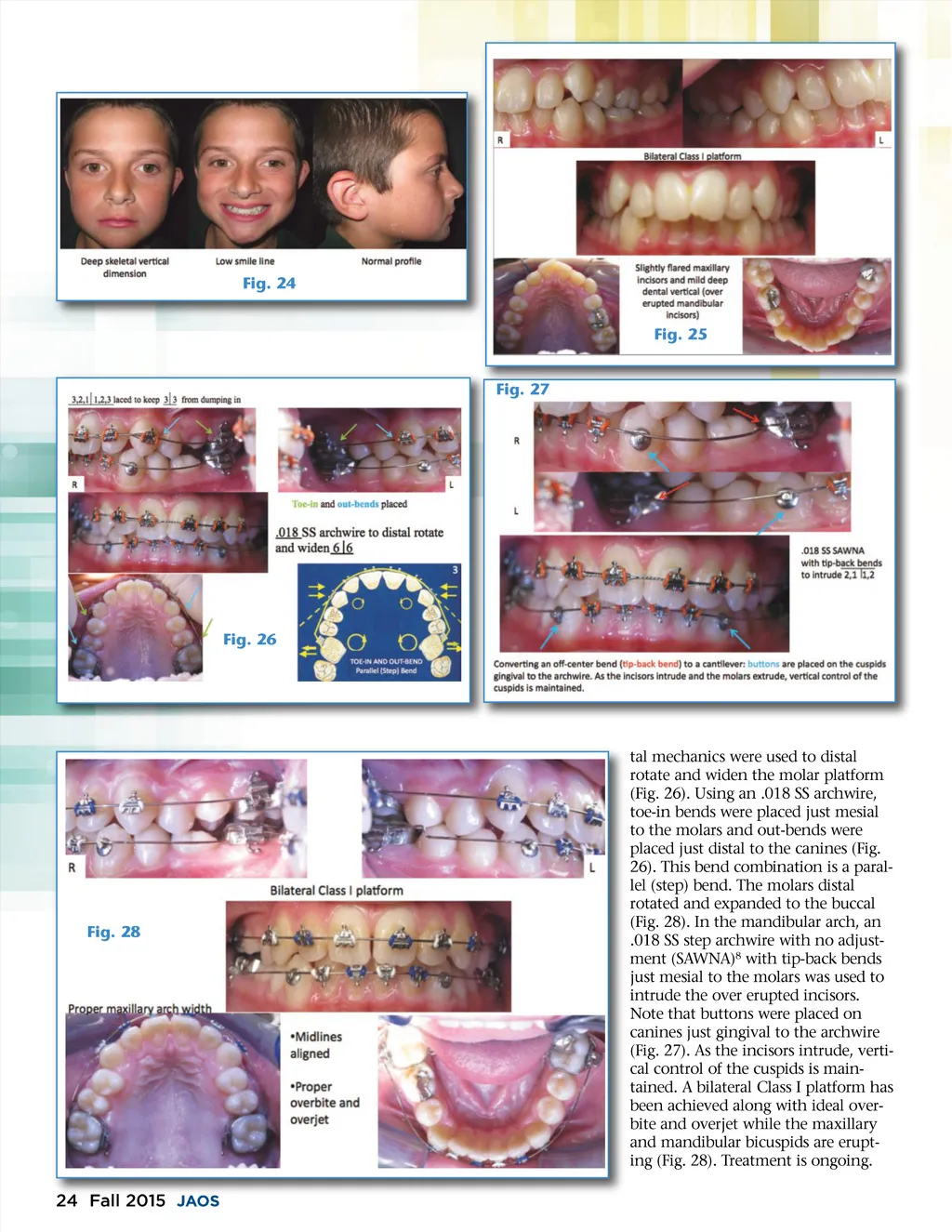
Fig. 24 Fig. 25 Fig. 27 Fig. 26 Fig. 28 tal mechanics were used to distal rotate and widen the molar platform (Fig. 26). Using an .018 SS archwire, toe-in bends were placed just mesial to the molars and out-bends were placed just distal to the canines (Fig. 26). This bend combination is a paral-lel (step) bend. The molars distal rotated and expanded to the buccal (Fig. 28). In the mandibular arch, an .018 SS step archwire with no adjust-ment (SAWNA) 8 with tip-back bends just mesial to the molars was used to intrude the over erupted incisors. Note that buttons were placed on canines just gingival to the archwire (Fig. 27). As the incisors intrude, verti-cal control of the cuspids is main-tained. A bilateral Class I platform has been achieved along with ideal over-bite and overjet while the maxillary and mandibular bicuspids are erupt-ing (Fig. 28). Treatment is ongoing. 24 Fall 2015 JAOS
Journal of the American Orthodontic Society Fall 2015: Page 24