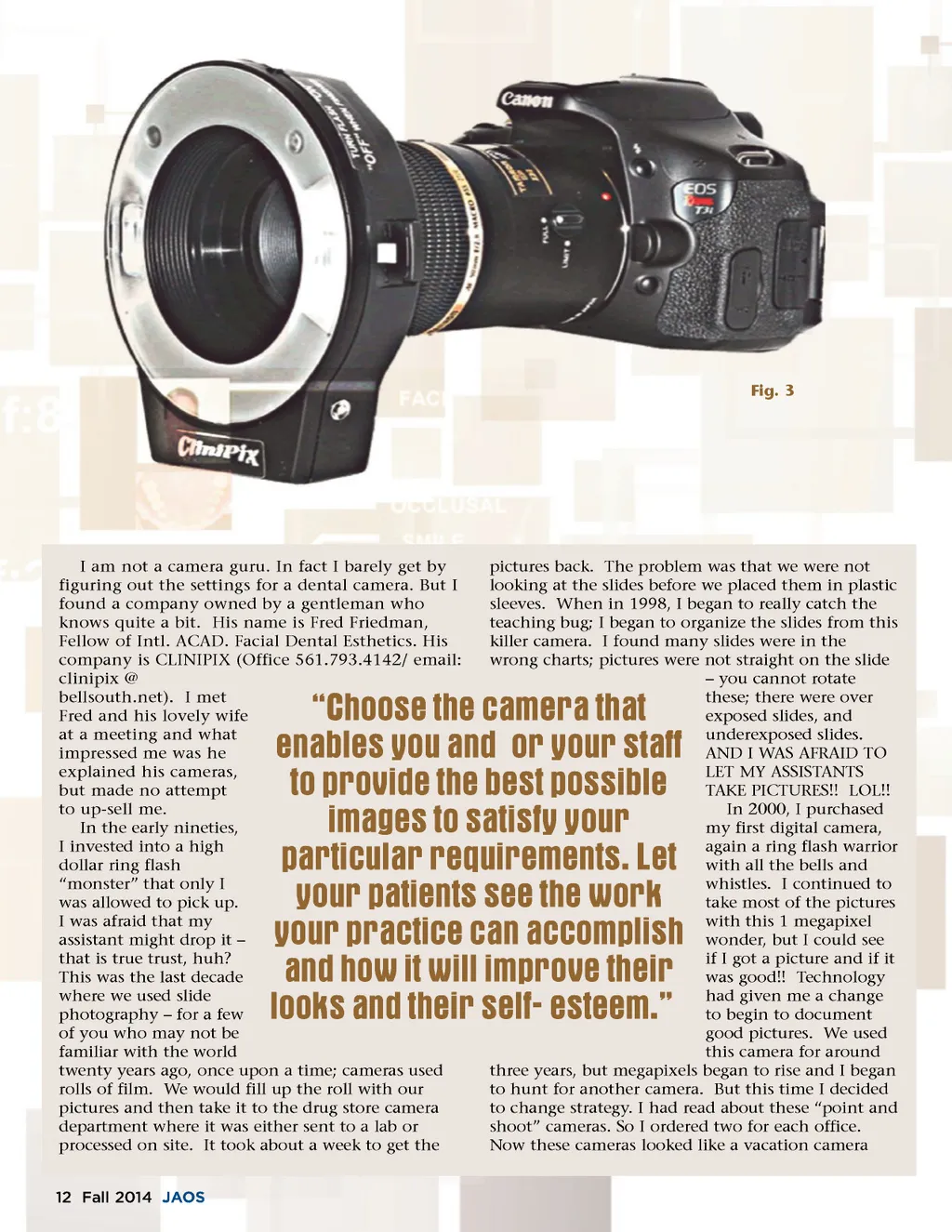
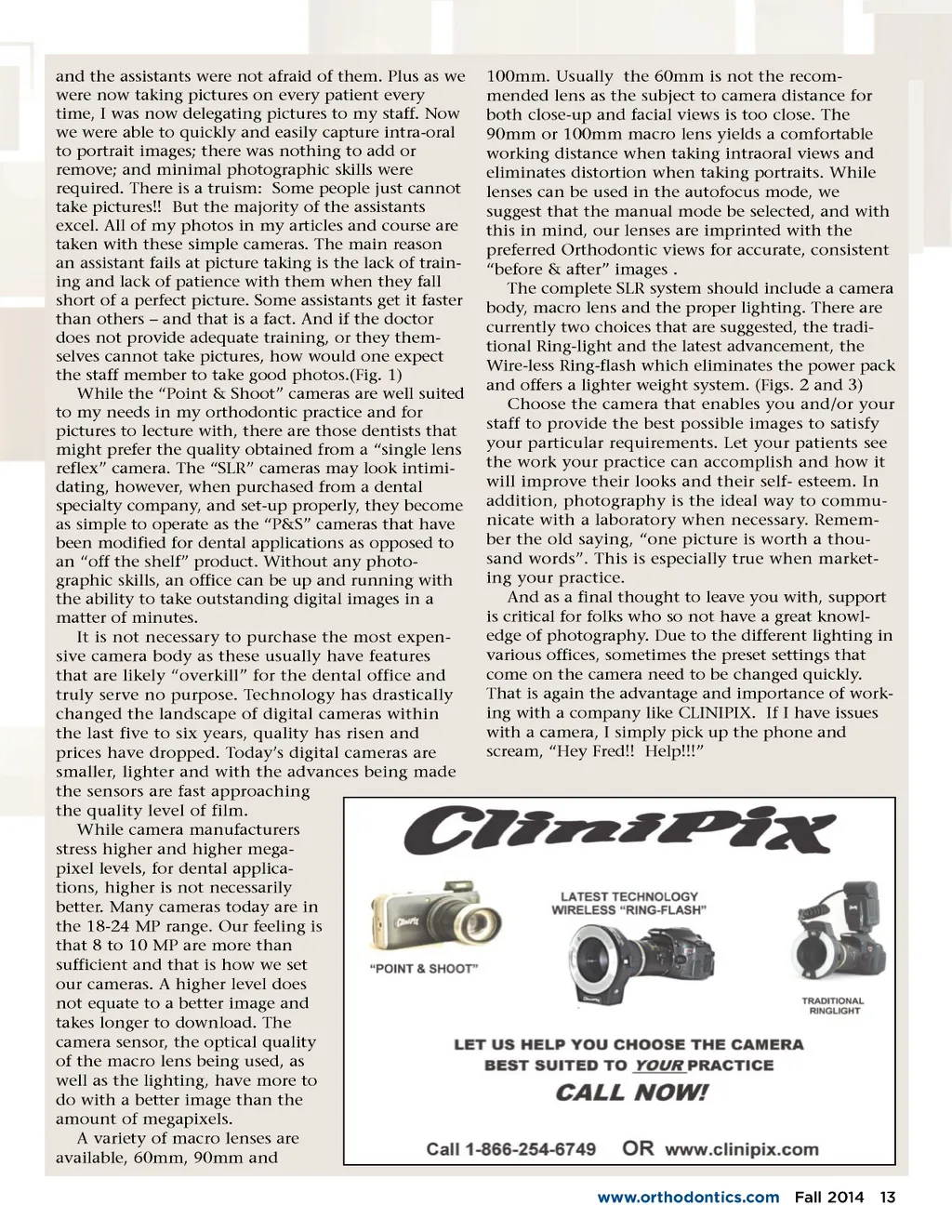
and the assistants were not afraid of them. Plus as we were now taking pictures on every patient every time, I was now delegating pictures to my staff. Now we were able to quickly and easily capture intra-oral to portrait images; there was nothing to add or remove; and minimal photographic skills were required. There is a truism: Some people just cannot take pictures!! But the majority of the assistants excel. All of my photos in my articles and course are taken with these simple cameras. The main reason an assistant fails at picture taking is the lack of train-ing and lack of patience with them when they fall short of a perfect picture. Some assistants get it faster than others – and that is a fact. And if the doctor does not provide adequate training, or they them-selves cannot take pictures, how would one expect the staff member to take good photos.(Fig. 1) While the “Point & Shoot” cameras are well suited to my needs in my orthodontic practice and for pictures to lecture with, there are those dentists that might prefer the quality obtained from a “single lens reflex” camera. The “SLR” cameras may look intimi-dating, however, when purchased from a dental specialty company, and set-up properly, they become as simple to operate as the “P&S” cameras that have been modified for dental applications as opposed to an “off the shelf” product. Without any photo-graphic skills, an office can be up and running with the ability to take outstanding digital images in a matter of minutes. It is not necessary to purchase the most expen-sive camera body as these usually have features that are likely “overkill” for the dental office and truly serve no purpose. Technology has drastically changed the landscape of digital cameras within the last five to six years, quality has risen and prices have dropped. Today’s digital cameras are smaller, lighter and with the advances being made the sensors are fast approaching the quality level of film. While camera manufacturers stress higher and higher mega-pixel levels, for dental applica-tions, higher is not necessarily better. Many cameras today are in the 18-24 MP range. Our feeling is that 8 to 10 MP are more than sufficient and that is how we set our cameras. A higher level does not equate to a better image and takes longer to download. The camera sensor, the optical quality of the macro lens being used, as well as the lighting, have more to do with a better image than the amount of megapixels. A variety of macro lenses are available, 60mm, 90mm and 100mm. Usually the 60mm is not the recom-mended lens as the subject to camera distance for both close-up and facial views is too close. The 90mm or 100mm macro lens yields a comfortable working distance when taking intraoral views and eliminates distortion when taking portraits. While lenses can be used in the autofocus mode, we suggest that the manual mode be selected, and with this in mind, our lenses are imprinted with the preferred Orthodontic views for accurate, consistent “before & after” images . The complete SLR system should include a camera body, macro lens and the proper lighting. There are currently two choices that are suggested, the tradi-tional Ring-light and the latest advancement, the Wire-less Ring-flash which eliminates the power pack and offers a lighter weight system. (Figs. 2 and 3) Choose the camera that enables you and/or your staff to provide the best possible images to satisfy your particular requirements. Let your patients see the work your practice can accomplish and how it will improve their looks and their self-esteem. In addition, photography is the ideal way to commu-nicate with a laboratory when necessary. Remem-ber the old saying, “one picture is worth a thou-sand words”. This is especially true when market-ing your practice. And as a final thought to leave you with, support is critical for folks who so not have a great knowl-edge of photography. Due to the different lighting in various offices, sometimes the preset settings that come on the camera need to be changed quickly. That is again the advantage and importance of work-ing with a company like CLINIPIX. If I have issues with a camera, I simply pick up the phone and scream, “Hey Fred!! Help!!!” www.orthodontics.com Fall 2014 13
Journal of the American Orthodontic Society Fall 2014: Page 13