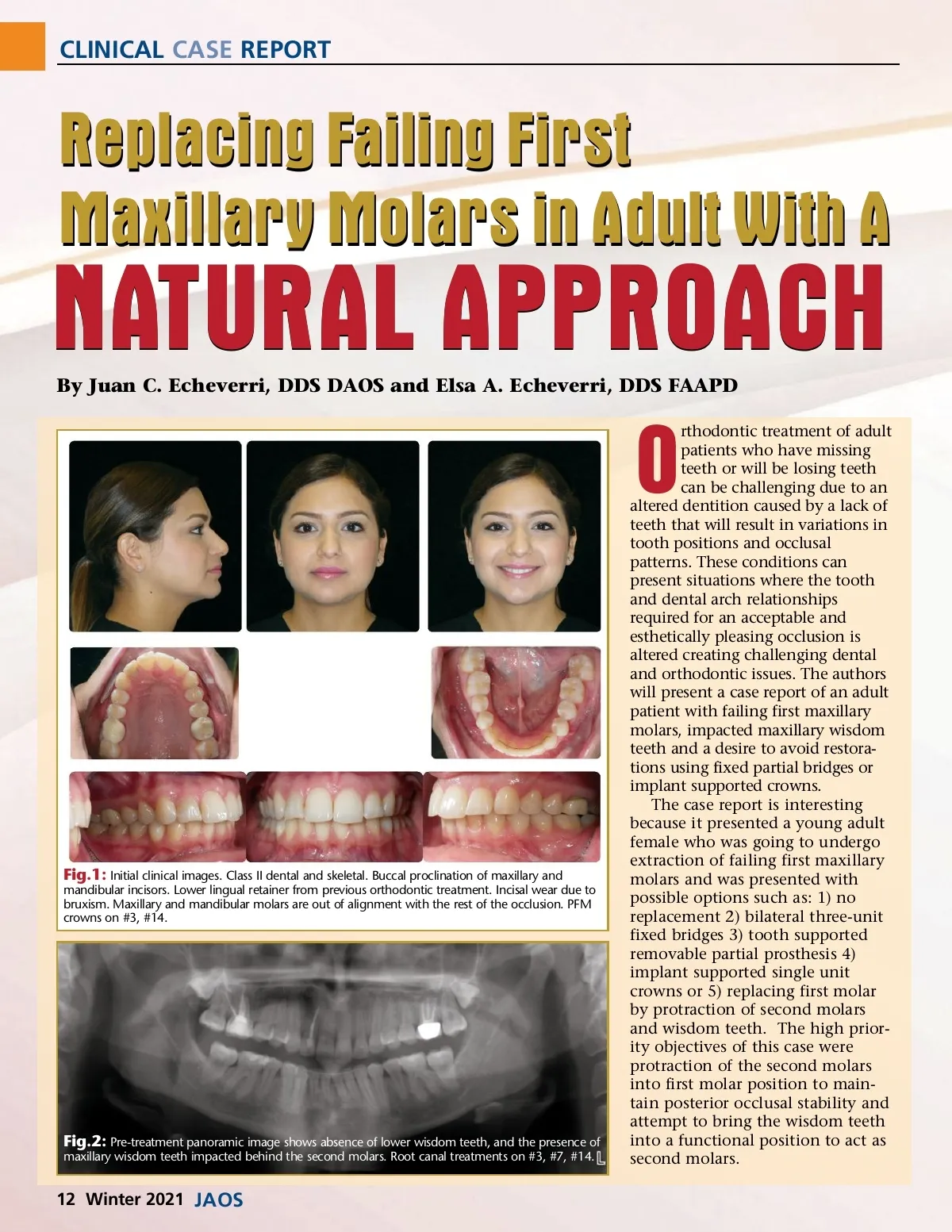
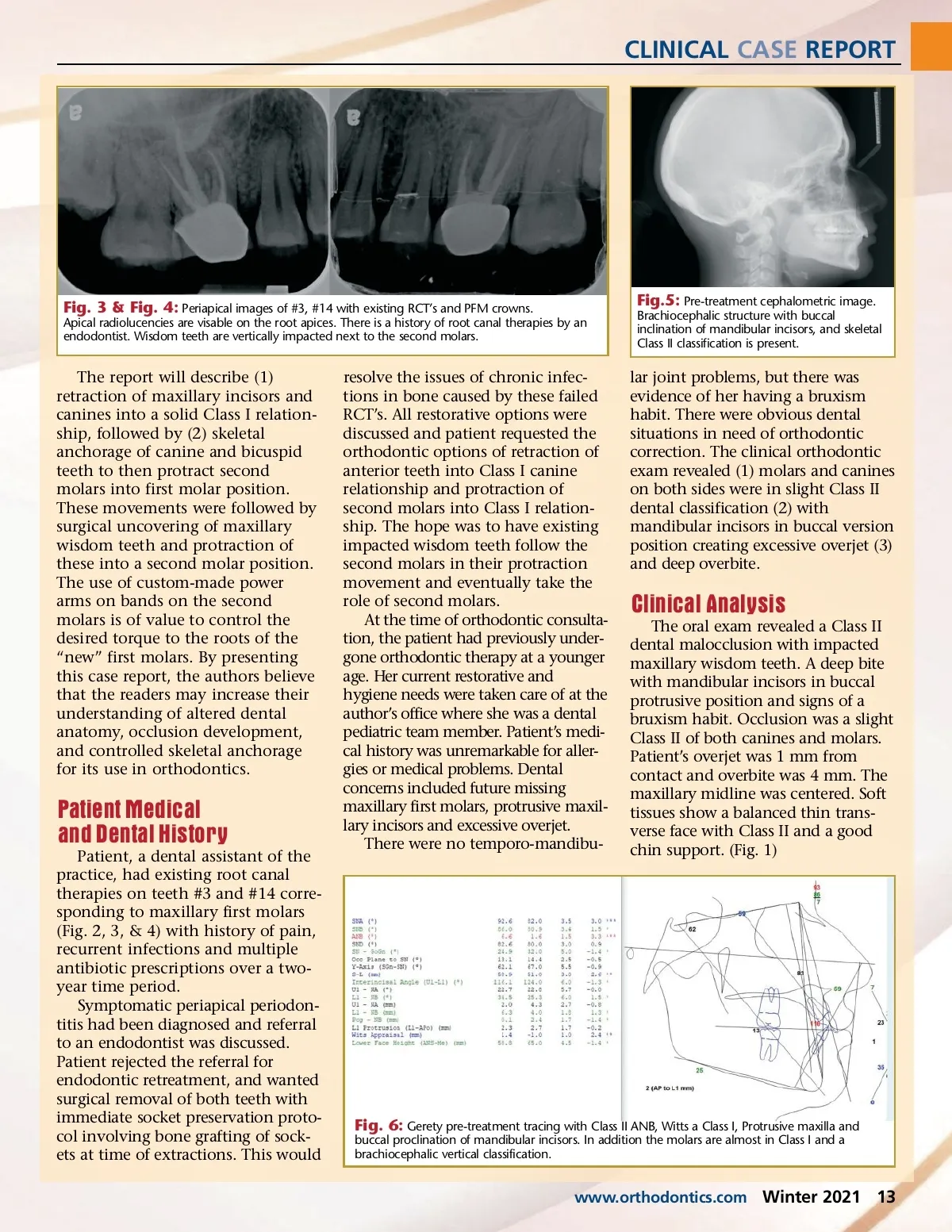
CLINICAL CASE REPORT Replacing Failing First Maxillary Molars in Adult With A NATURAL APPROACH By Juan C. Echeverri, DDS DAOS and Elsa A. Echeverri, DDS FAAPD rthodontic treatment of adult patients who have missing teeth or will be losing teeth can be challenging due to an altered dentition caused by a lack of teeth that will result in variations in tooth positions and occlusal patterns. These conditions can present situations where the tooth and dental arch relationships required for an acceptable and esthetically pleasing occlusion is altered creating challenging dental and orthodontic issues. The authors will present a case report of an adult patient with failing first maxillary molars, impacted maxillary wisdom teeth and a desire to avoid restora-tions using fixed partial bridges or implant supported crowns. The case report is interesting because it presented a young adult female who was going to undergo extraction of failing first maxillary molars and was presented with possible options such as: 1) no replacement 2) bilateral three-unit fixed bridges 3) tooth supported removable partial prosthesis 4) implant supported single unit crowns or 5) replacing first molar by protraction of second molars and wisdom teeth. The high prior-ity objectives of this case were protraction of the second molars into first molar position to main-tain posterior occlusal stability and attempt to bring the wisdom teeth into a functional position to act as second molars. O Fig.1: Initial clinical images. Class II dental and skeletal. Buccal proclination of maxillary and mandibular incisors. Lower lingual retainer from previous orthodontic treatment. Incisal wear due to bruxism. Maxillary and mandibular molars are out of alignment with the rest of the occlusion. PFM crowns on #3, #14. Fig.2: Pre-treatment panoramic image shows absence of lower wisdom teeth, and the presence of maxillary wisdom teeth impacted behind the second molars. Root canal treatments on #3, #7, #14. 12 Winter 2021 JAOS
Journal of the American Orthodontic Society Winter 2021: Page 12