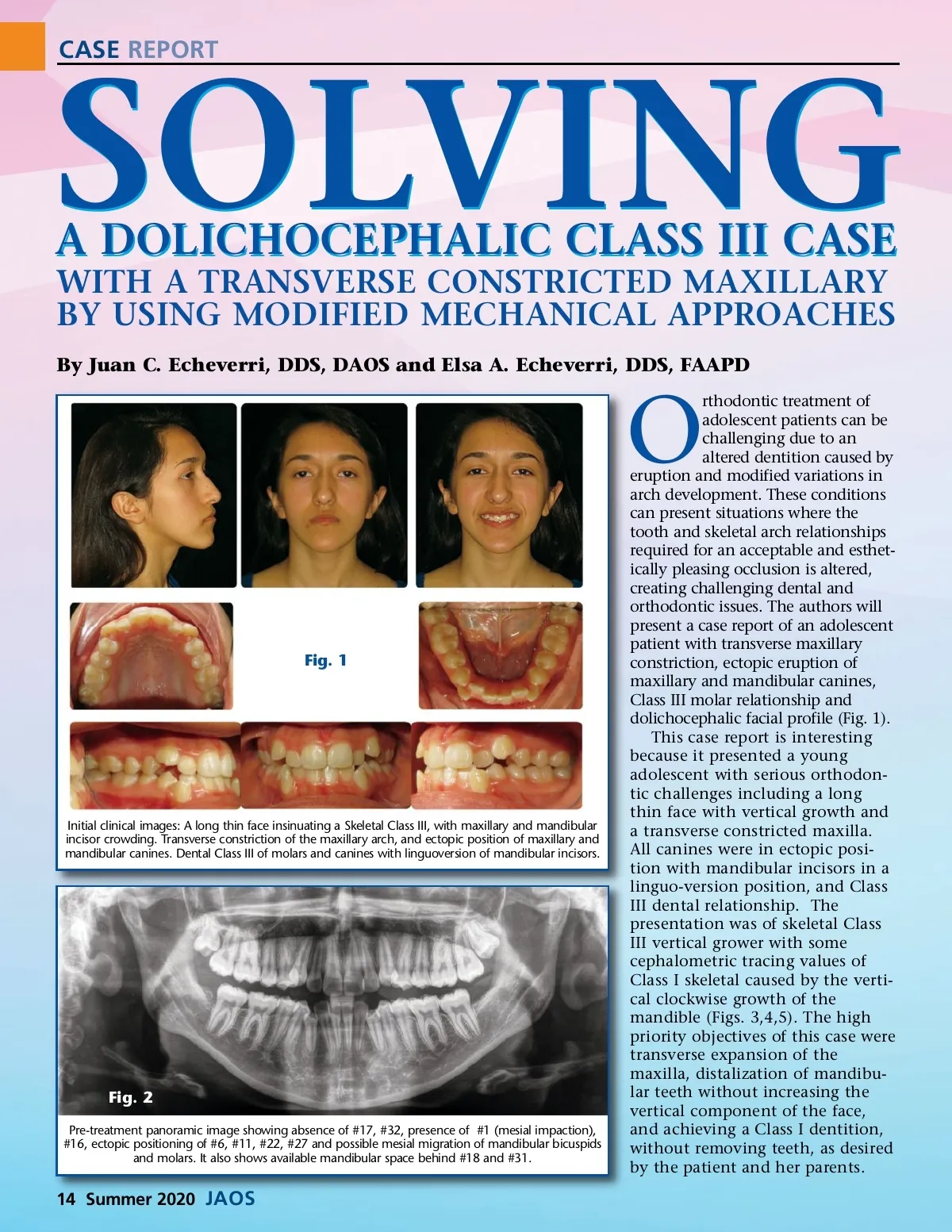
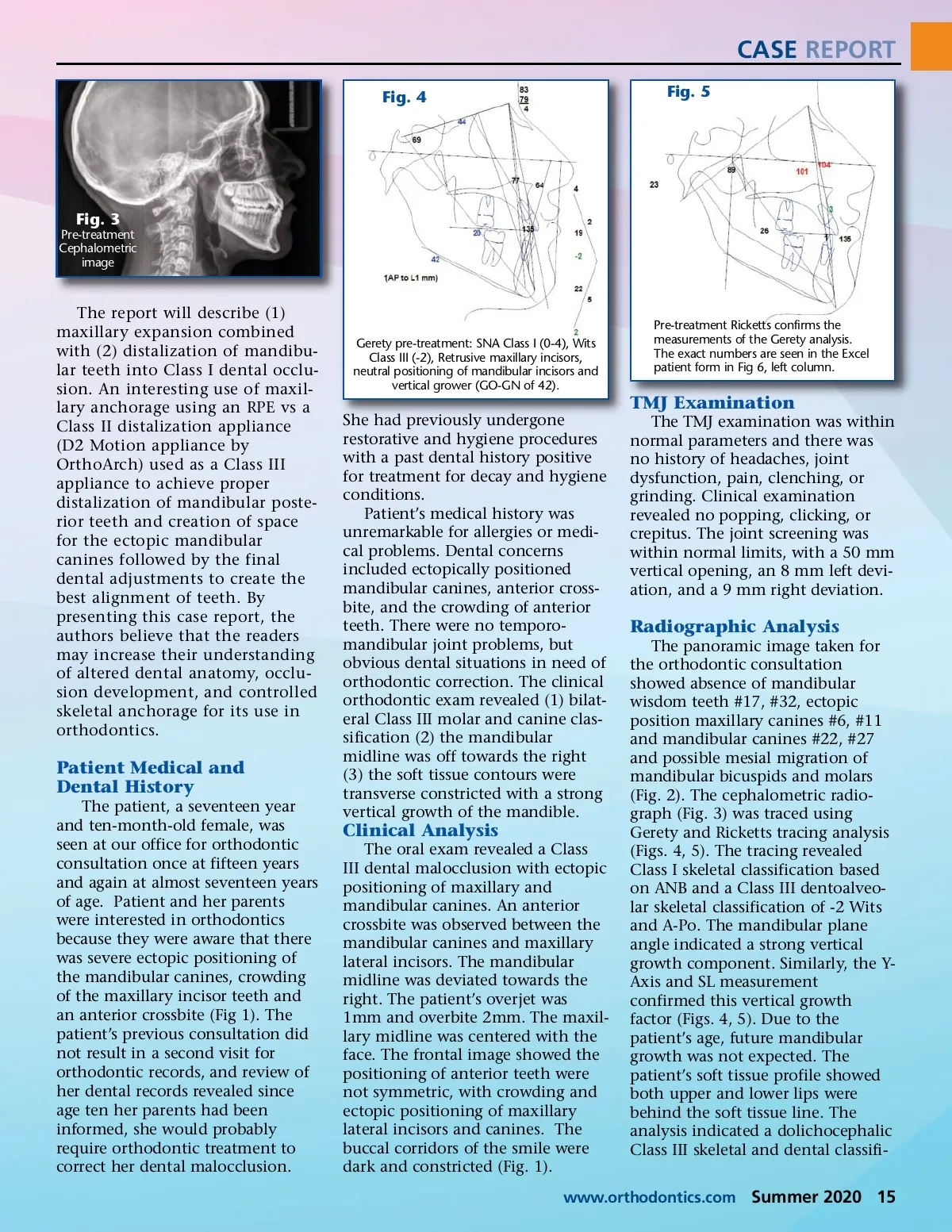
CASE REPORT SOLVING A DOLICHOCEPHALIC CLASS III CASE WITH A TRANSVERSE CONSTRICTED MAXILLARY BY USING MODIFIED MECHANICAL APPROACHES By Juan C. Echeverri, DDS, DAOS and Elsa A. Echeverri, DDS, FAAPD O Fig. 1 Initial clinical images: A long thin face insinuating a Skeletal Class III, with maxillary and mandibular incisor crowding. Transverse constriction of the maxillary arch, and ectopic position of maxillary and mandibular canines. Dental Class III of molars and canines with linguoversion of mandibular incisors. Fig. 2 Pre-treatment panoramic image showing absence of #17, #32, presence of #1 (mesial impaction), #16, ectopic positioning of #6, #11, #22, #27 and possible mesial migration of mandibular bicuspids and molars. It also shows available mandibular space behind #18 and #31. rthodontic treatment of adolescent patients can be challenging due to an altered dentition caused by eruption and modified variations in arch development. These conditions can present situations where the tooth and skeletal arch relationships required for an acceptable and esthet-ically pleasing occlusion is altered, creating challenging dental and orthodontic issues. The authors will present a case report of an adolescent patient with transverse maxillary constriction, ectopic eruption of maxillary and mandibular canines, Class III molar relationship and dolichocephalic facial profile (Fig. 1). This case report is interesting because it presented a young adolescent with serious orthodon-tic challenges including a long thin face with vertical growth and a transverse constricted maxilla. All canines were in ectopic posi-tion with mandibular incisors in a linguo-version position, and Class III dental relationship. The presentation was of skeletal Class III vertical grower with some cephalometric tracing values of Class I skeletal caused by the verti-cal clockwise growth of the mandible (Figs. 3,4,5). The high priority objectives of this case were transverse expansion of the maxilla, distalization of mandibu-lar teeth without increasing the vertical component of the face, and achieving a Class I dentition, without removing teeth, as desired by the patient and her parents. 14 Summer 2020 JAOS
Journal of the American Orthodontic Society Summer 2020: Page 14